Sunday, January 9, 2011

Deer Habitat Workshop for Landowners or A chainsaw is the Deer's Best Friend

Did you know that, without the small land-owners help, the deer herd is not expected to reach normal levels in 30 years! If we, as land-owners get busy, maybe we can acheive l980 levels in 10 years!!! If you are a land-owner, and enjoy the presence of deer, than you can't afford to miss this workshop.

Rangeley Region Guides & Sportsmen's Club is proud to host a free workshop for members and the public on managing own's property to enhance deer sustainability. On Saturday, March 12, 8:30-12:00, this workshop is designed for the Upper Kennebec Valley chapter of SWOAM. What is SWOAM? It is an organization of small Maine land-owners meant to teach the owner management techniques of forest sustainability. It also educates about tax breaks, provides informative newsletters, easements and profit-making.

Anyone is invited to attend this Saturday workshop at the Oquossoc Clubhouse. Coffee and cookies available at the Clubhouse 8:30, followed by a 9:00 talk on deer ecology and timber management techniques with IF+W Biologists Chuck Hulsey and Bob Cordes. The participants will then tour the work the Rangeley Lakes Heritage Trust folks have done to increase deer habitat on Trust land. This is a great workshop for those who would love a little more guidance on how to manage their land to encourage deer, or those just interested in deer ecology. Foresters will also be hand to discuss spruce/fir management relative to deer habitat.

Please dress for the weather and bring showshoes if you have them. The outside portion will involve a short walk. This workshop is sponsored by the SWOAM, the Rangeley Region Guides and Sportsmen’s Association, IF+W, and the Maine Forest Service.

Directions: Once in Oquossoc , Continuing West on Highway 4, turn left at the 2nd intersection past the Oquossoc Post Office. Drive 2 blocks and you will see the Club House on the right.

Any questions, contact Marcia at 864-3351 marciambaker@hotmail.com or Patty Cormier at 592-2238 , patty.cormier@maine.gov.

Saturday, December 4, 2010

Experts Give Projects a Visit

This fall, both projects, Apple Tree Release and Food Plots received much attention. One of our active volunteers, Andy Nagle accompanied Steve Goodwin, Dean of U. Mass. Dept of Agriculture and Natural Science. Dean Goodwin was especially interested in our Apple Tree Release Program, and has offered any help. Thanks to his department, we have learned that the Quimby Pond apple trees are called "winter banana". The ones we ate, were surprising sweet and delicious for stressed trees. We have now completed the first phase of clearing more sunlight for 34 apple trees. We await another consulting visit from Steve's colleague in the spring, to determine if the larger competing trees should be professionally removed.
Bob Cordes, deer biologist from IF & W,, has made two trips to our Rangeley plots. He was impressed how much deer and moose use the Cross-Town plots. He felt that the clover is solidly established and will produce adequately the next few years. He recommended we replant with the annuals, buckwheat and oats to help the does produce strong offspring this early summer. He thought over-planting forage turnip along the periphery next year would help the deer's winter endurance. On a second trip, he visited the Flat Iron Plot, and confirmed late-season deer usuage, as the deer migrate through this area on the way into Oqoussoc. Planting the annuals, Turnip and buckwheat will be considered here as well. The control plot did fairly well, probably germinating 30% because its soil ph was pretty good to start with. Bob, you will recall, was the biologist that helped Marcia to design the Rangeley Seed Mix. In the picture, he is looking at some of the ryegrass, and pleased with the obvious success of the plots. We are lucky to have such close access to the expertise Bob Cordess and Chuck Hulsey.

Bob and his little girl, Madison, accompanied Marcia, Ron Ray and Kent Cummings to visit some new potential plots for next year.
Bob agreed with Ron Ray, Guide and Moniter, that these plots met all the criteria: south-facing, along the winter deer corrider, good drainage and good cover. Ash will again be used. This location will be proposed to Seven Islands.

Our visitor, Andy Weik, grouse biologist from Ruffed Grouse Society gave us a very educational presentation on managing grouse and woodcock habitat. This can be done maintaining habitats of various ages. Ruffed grouse are most common in patches that are covered by trees 5-15 years old. The land-owner should strive to maintain forest of different ages. Harvesting a 5-10 acre every 10 years easily provides a mix of age classes. So folks, remember that small clear-cuts are the best thing we can do for all our wildlife. Another excellent technique is cutting down strips of alder to give woodcock more access to earthworms, their main food source. A chainsaw is the best friend of most wildlife.
While touring our plots, Andy recommended cutting a few narrow corriders entering the plots. This would better serve woodcock and other wildlife. He also discovered that rabbits have been browsing the plots that had good cover. Prior to his presentation, Andy also got a chance to hunt grouse with Rick Baker.
If any of you are interested in learning more, please join the Ruffed Grouse Society 888-564-6747. The quarterly magazine is really excellent.


Tuesday, November 16, 2010

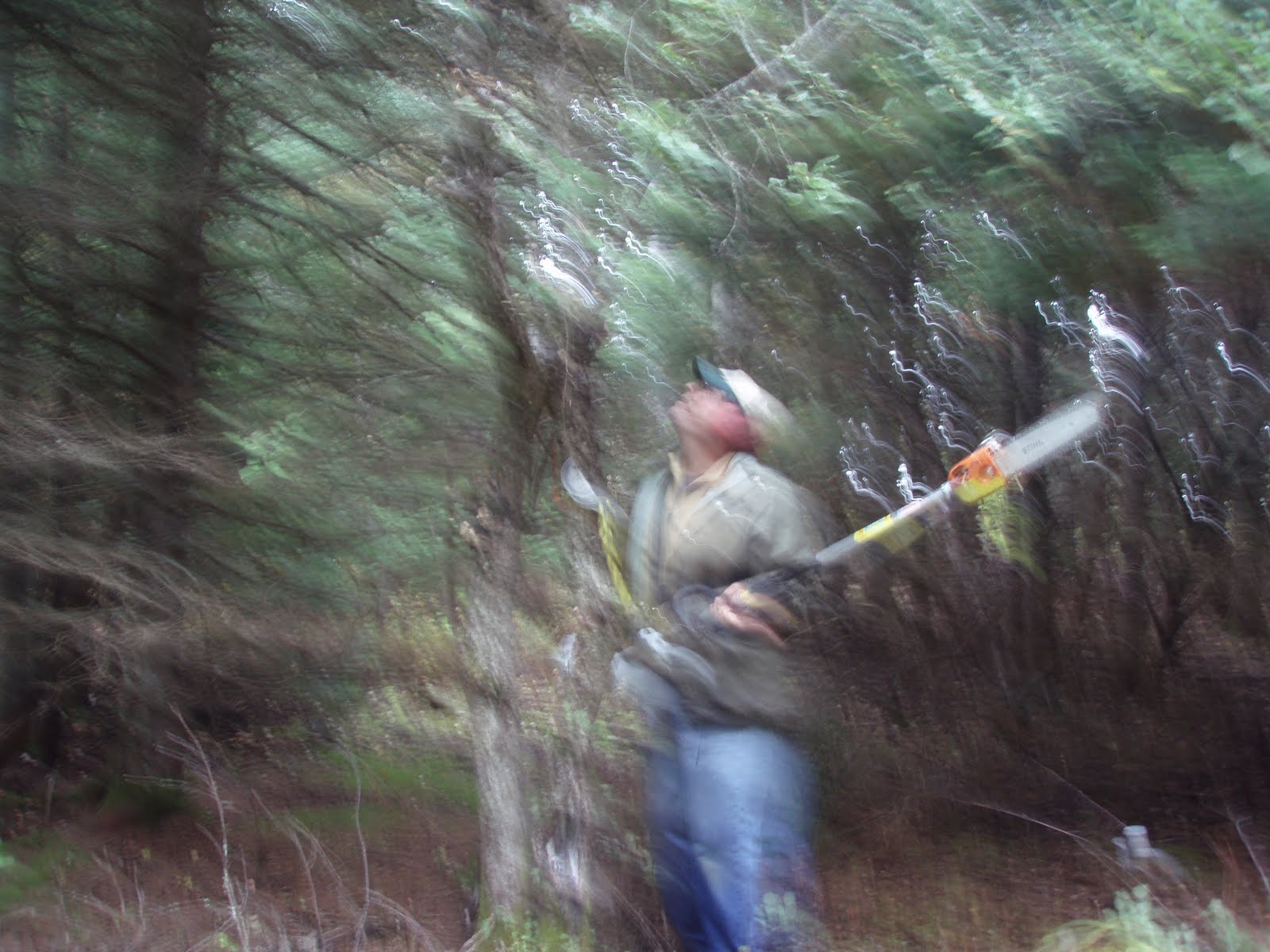
CHAIN SAW MASSACRE?!

No, you aren't a witness to a gruesome murder. Instead, you see Michael Warren (red checked coat) clearing an outlying apple tree. Despite inclement weather, Oct 29th was our last clinic of the year.


Gino Nali and Michael W. team up.


To your left are the dynamic couple Kevin and Doreen Sinnett. Below is our own Marilyn Bronton slinging brush.

Below: Gino Nali trimming with Sheri Oldham, (lt. green jacket) who has traded in her former surgeon's gown for Kevlar chaps. I wonder if she makes precision cuts with that chain saw.

All in all, we have released a total of 34 apple trees, ending the first phase of this location. I keep on getting asked, "What's being released?" LIGHT. We are clearing around the trees, so that the crowns can be exposed to more sunlight.


Saturday, October 16, 2010

A Glimmer of Light

This stealth camera, shown here being installed by Rick Baker was stolen. Several days later, another camera , owned by Lynn Hewey, was stolen. In the latter case, the tree was cut down, in order to remove the locked camera. These personal cameras were being used to evaluate how much the forage was eaten on the plots. It was discouraging to all of us who are trying to do some good for our wildlife.

When Jared Austin heard about this misfortune, he contacted Stealth.cam. This company stepped up to plate and donated a camera to the club. They also gave Rick and Lyn a large discount to replace their cameras. Such kindness helped those of us who were deeply disillusioned by this act. I hope you will consider Stealth.cam if you buy a game camera in the future.

Third Apple Tree Release Clinic

With just a mid-week crew of five, we exceeded our goals. Not only did we get the clean-up done, with two wildmen (Bob Booker and Chick Hembrow) bearing chainsaws, we released an extra seven apple trees, and fertilized the ones from last cutting. This means that we have released 24 apple trees that will provide cover (from the accumulated brush piles) and nourishment to countless animal and bird species. This is all from 3 occasions with 6 hours of labor.
Below you see Bob Booker ( in green plaid) and Andy Chabot, both over 80 years old clearing and piling limbs. Remarkable. Need I say more?


Andy Chabot, in red plain jacket, a Trac Club member, drove all the way from Saco, to help with this project. Thanks Andy for your dedication.


(Below) Mary Henbrow and Chuck really going to it!


Last cutting will be October 31, Sunday from 1:00 - 3:00. Call Marcia at 864-3351 if you would like to help.


Helping Wildlife on your Property


Two new books for RRG & SA members will be available at the Club House for lending. You may check them out at meeting time and keep it until next meeting. See Elaine Holcum or Marcia Baker.

The book "Grow 'Em Right" by Neil and Dougherty, talks about simple Timber Stand Improvement (TSI), that only requires your time and some tools. They claim that the chainsaw is the deer's best friend. It also takes into account issues planting plots in northern timberland like ours.

Quality Food Plots, zeros in on planting food plots on your property. The authors, Kammermeyer, Miller and Thomas, distinquish between climates. It also gives a run-down on every kind of seed you are considering. Both books do recommend commercial seed-mixes although they are more expensive, compared to using The Rangeley Mix, our Association designed. Both books talk about seeding logging roads or power lines.

You can just buy a few seed packets of turnips, plant them in the spring, and that will be the best way to provide food to deer up until January. The deer only start eating turnips after frost-time when a chemical reaction triggers an attraction. (As always we recommend liming or ash to sweeten the soil). Their stems remain upright even under the snow. Turnip , and other brassicas like it, are the only nutritious plant family that endures our climate. Otherwise, we have to hope that food plots will fatten up the deer enough to carry them until the spring.

The photo below shows Andy Nagle checking out his scattered food plots. In this case, he used clover which is an excellent perennial that will last for two or three years. Here he is checking out how they grew during the summer. Like Andy, start small and experiment.


At the next RRG & SA meeting, on Oct 21, we are happy to have Chuck Hulsey, deer biologist, talk about the new partnership of large and small landowners in managing winter deeryards. I hope you can be there

Thursday, September 30, 2010

Another Dent in the Apple Tree Project

On Sept 26, four brave souls endured the drizzle to once again work on the apple tree orchard that is being choked out by mature forest.


To your left is Sam Spaulding, professional forester, downing the nearby trees so that the apple trees will be exposed to more light. Sunlight is the most important thing to restore these trees. You will note an apple tree trunk to the left of the picture with its own identifying tag.


Gino Nalli is using a specialized chainsaw that can saw off the dead wood in no time.


Gary Languille, who hails from Cape Cod, also fell many trees.
Because of such a small work party, we will have to reschedule to delimb and clean up. We also will be fertilizing the trees.
Mark your calendar. Next tentative date will be October 13, at 1:00 in the Quimby Pond area. Call marcia for directions. Bring your shears and pruners.

Thank you fellas for helping to make a difference.